
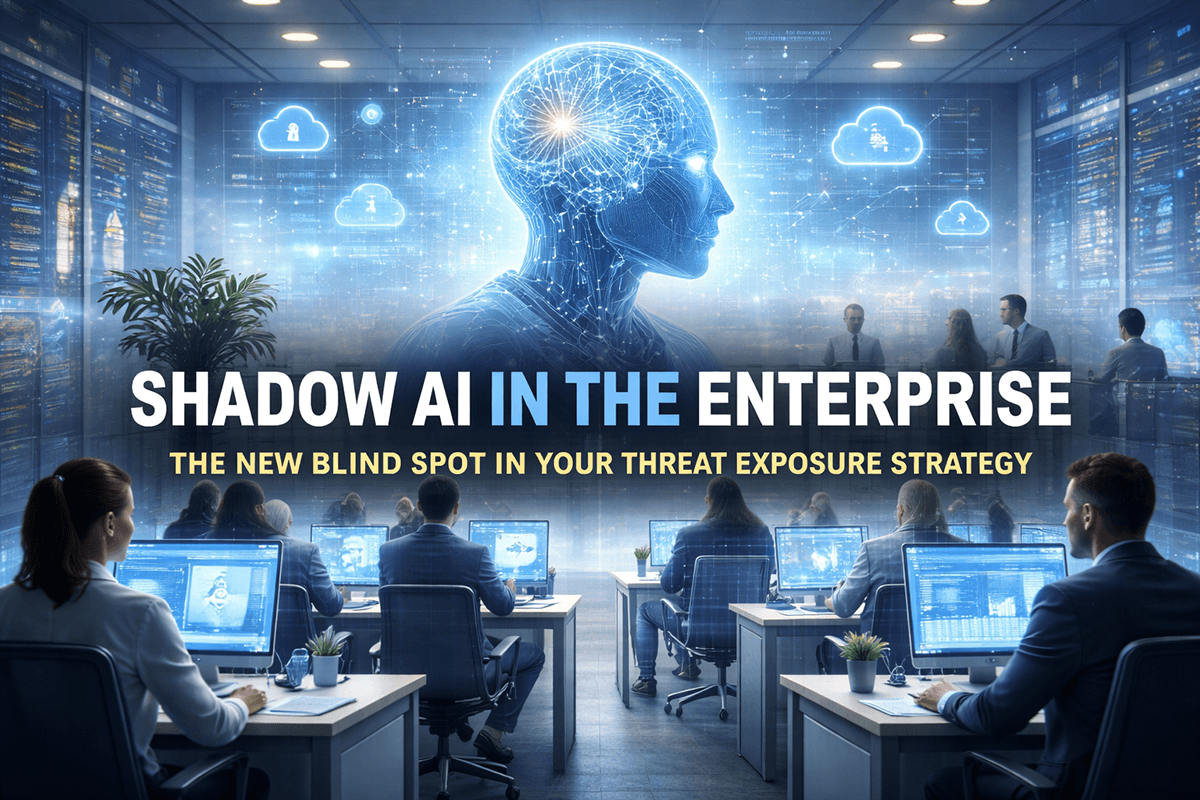
Shadow AI in the Enterprise: The New Blind Spot in Your Threat Exposure Strategy
Over the last few years, organizations have made meaningful progress in understanding and managing their attack surface. From asset discovery to continuous threat exposure management (CTEM), security leaders now have better visibility into where risks exist and how attackers might exploit them.
But there’s a growing problem.
Most of these efforts are still focused on known assets and visible systems.
Meanwhile, a new and largely unmonitored layer of risk is expanding rapidly inside the enterprise Shadow AI.
Shadow AI refers to the unauthorized or unmanaged use of AI tools within an organization, often driven by employees looking to improve productivity. It includes everything from using public generative AI platforms to integrating AI into workflows without IT oversight.
And here’s the uncomfortable truth:
You can’t manage what you can’t see and most organizations have little to no visibility into their AI usage today.
This is not just another security trend. It’s a fundamental shift in how risk is introduced into the enterprise.
In this blog, we’ll explore the current AI landscape, the cybersecurity risks of Shadow AI, and a practical roadmap for organizations looking to regain control without slowing innovation.
The Current AI Landscape in Enterprises
AI adoption has moved faster than any previous technology wave.
Today, employees across functions are using generative AI tools to:
- Draft content and communications
- Analyze large datasets
- Automate repetitive processes
- Accelerate software development
The accessibility of these tools has created a new reality: AI is now part of everyday work, not a controlled IT initiative.
But while adoption has accelerated, governance has not kept pace.
In most enterprises:
- Multiple AI tools are being used simultaneously
- Many of these tools are not approved or vetted
- Data is being shared externally with little oversight
Even organizations that provide approved AI solutions are seeing widespread use of external tools.
This is the essence of Shadow AI risk a decentralized, fast growing layer of technology that operates outside traditional security controls.
And unlike traditional shadow IT, Shadow AI is more dynamic, more accessible, and far harder to track.
Threats Faced by Organizations
Shadow AI introduces a new category of enterprise cybersecurity risk one that blends human behavior, data exposure, and third-party dependencies.
1. Data Leakage Through Everyday Use
One of the most immediate risks is unintentional data exposure.
Employees routinely input:
- Sensitive business data
- Customer information
- Internal reports
- Proprietary code
into AI tools to improve outputs.
From a user perspective, this is harmless. From a security perspective, it’s a loss of control.
Once that data leaves your environment, you no longer control:
- Where it is stored
- How it is processed
- Who can access it
This is one of the most critical AI security risks for businesses today.
2. Lack of Visibility Across AI Usage
Most organizations cannot answer a simple question:
“Which AI tools are currently being used across the business?”
Traditional security solutions are not designed to track:
- Browser-based AI usage
- API-level AI integrations
- Data flows into external AI platforms
This creates a significant visibility gap in your attack surface and a blind spot in your exposure management strategy.
3. Compliance and Regulatory Exposure
As regulations around data privacy and AI governance evolve, Shadow AI introduces serious compliance challenges.
Organizations may unknowingly:
- Share regulated data with external platforms
- Violate data residency requirements
- Lose auditability of sensitive data usage
This is particularly critical for industries with strict compliance requirements.
4. Expansion of the Enterprise Attack Surface
Every AI tool approved or not extends your enterprise attack surface.
Unlike traditional software, AI tools:
- Interact dynamically with data
- Generate outputs that may be reused downstream
- Integrate with other systems through APIs
This introduces risks such as:
- AI-generated insecure code entering production
- Vulnerabilities through unvetted integrations
- Manipulation via malicious prompts
In effect, Shadow AI creates an unmanaged extension of your digital environment.
5. Persistent and Compounding Risk
Shadow AI is not temporary.
Once adopted, tools become embedded in workflows. Over time:
- Usage increases
- More sensitive data is shared
- Dependencies grow
What starts as a productivity shortcut can quickly evolve into a systemic risk.
6. Business Impact and Breach Costs
Organizations with unmanaged Shadow AI exposure face:
- Higher likelihood of data breaches
- Increased incident response complexity
- Greater financial and reputational impact
The connection is clear:
The less visibility you have into AI usage, the greater your exposure.
Suggested Roadmap: Managing Shadow AI Risk
Addressing Shadow AI is not about restriction it’s about control, visibility, and enablement.
1. Gain Visibility into AI Usage
Start by identifying:
- Which AI tools are being used
- Who is using them
- How they interact with your data
This is the foundation of any effective AI risk management strategy.
2. Establish Clear AI Governance Policies
Define:
- Approved AI tools
- Acceptable use cases
- Data sharing guidelines
Policies should be practical, enforceable, and aligned with business needs not just theoretical.
3. Strengthen Data Protection Controls
Protect sensitive data before it reaches AI tools through:
- Data classification
- Access management
- Data loss prevention (DLP)
This ensures that even if AI tools are used, critical data remains secure.
4. Integrate AI into Your Security Framework
Shadow AI should be included in:
- Threat exposure management
- Risk assessments
- Attack surface analysis
This aligns AI usage with your broader cybersecurity strategy.
5. Provide Secure AI Alternatives
If you don’t provide secure options, employees will find their own.
Enable adoption of:
- Approved enterprise AI platforms
- Secure integrations
- Controlled environments for experimentation
6. Continuously Monitor and Adapt
Shadow AI is constantly evolving.
Organizations must:
- Continuously monitor usage
- Update policies and controls
- Adapt to new threats
The Role of Employees
Employees are central to the rise of Shadow AI but they are also key to managing it.
Most usage is driven by a simple goal: getting work done faster.
To reduce risk, organizations need to focus on:
- Awareness: Helping employees understand AI security risks
- Clarity: Providing clear guidance on acceptable use
- Enablement: Offering secure tools that meet their needs
Security improves when the secure option is also the easiest option.
The Role of IT and Security Teams
Shadow AI requires a shift in how security teams operate.
Move Beyond Traditional Control Models
Blocking tools is not scalable.
Security teams need to move toward:
- Controlled enablement
- Risk based decision making
- Business aligned security strategies
Improve Visibility and Monitoring
This is non-negotiable.
Organizations need capabilities to:
- Discover AI usage
- Monitor data flows
- Identify high risk behavior
Collaborate Across the Organization
Shadow AI spans multiple functions.
Effective management requires collaboration between:
- Security teams
- Business leaders
- Legal and compliance teams
Build AI-Aware Security Programs
Security strategies must evolve to include:
- AI-specific risk models
- Updated threat scenarios
- AI-aware incident response planning
Conclusion
Shadow AI is redefining the enterprise attack surface.
It is:
- Decentralized
- Employee driven
- Rapidly expanding
And most importantly, it operates outside traditional visibility.
Organizations that continue to focus only on infrastructure and external threats will miss this growing risk.
The organizations that stay ahead will be those that:
- Expand visibility into AI usage
- Integrate AI into exposure management
- Balance security with innovation
Because today, your biggest risk may not be what’s attacking your systems, it’s what your employees are using every day.
Shadow AI is already part of your environment.
The real question is:
Do you have visibility and control over it?
At Candor, we help organizations:
- Identify hidden exposure across their attack surface
- Uncover unmanaged risks including Shadow AI
- Build practical, scalable strategies for modern cybersecurity challenges
If you’re looking to understand how Shadow AI is impacting your organization and how to manage it effectively
👉 Get in touch with our team today.
Because in today’s threat landscape, visibility isn’t optional it’s everything.