


On-Prem Servers Are Now Resting: A Real Story About Business Continuity, Geo-Redundancy, and What Happens When the Internet Goes Down
A client of ours, a business operating in a region under significant pressure called us some weeks ago with a request that had become urgent. They needed to move their entire ERP system and database to the cloud. Not as part of a long-term digital transformation roadmap. Right now.
The conflict in the region had changed the calculus entirely. Public cloud infrastructure locally was coming under pressure. On-premise servers felt increasingly exposed. The business needed its operations and its data somewhere safe, somewhere geographically removed from the disruption, and somewhere it could keep working regardless of what happened on the ground.
We had seven days.
The plan was to run the cloud environment in parallel with on-premise until the client’s financial year end in March a sensible transition that would give the team time to adapt and validate the new environment before fully cutting over. But events moved faster than the plan.
Internet connectivity went down. The firewall followed. The on-premise ERP, the system the entire business ran on went dark.
The client opened a browser, navigated to their cloud URL, and kept working.
The on-premise servers have been resting ever since.
What Made That Moment Possible: The Three-Layer Architecture
The reason the client could keep working when their local environment failed was not luck and it was not a last-minute scramble. It was the result of a deliberate architectural decision made seven days earlier, to build resilience into the cloud environment itself, not just at the backup layer.
Most businesses think about data protection in one dimension: backup.
Do you have a copy of your data somewhere? The answer for most is yes though as we covered in our post on ransomware resilience, whether that backup is actually tested and recoverable is a different question.
What this client needed and what the current regional environment increasingly demands is resilience across three distinct layers:
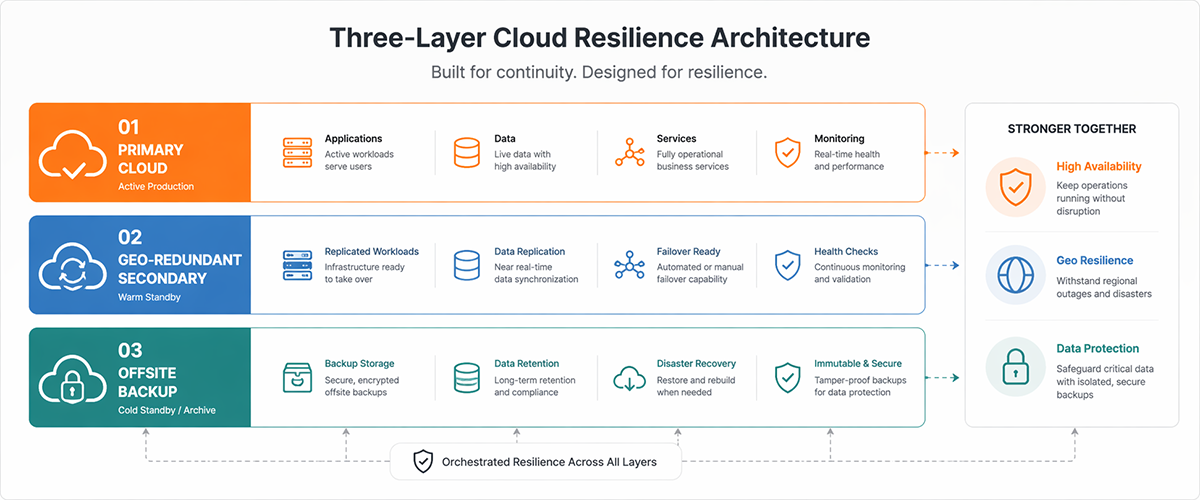
| Layer | Platform | Location | Role | |
| Layer 1 | Primary Cloud Environment | A leading global public cloud platform | Outside the affected region | Live production environment. All ERP workloads running here. Geo-separated from UAE infrastructure. Business operates from here in normal conditions and under regional disruption. |
| Layer 2 | Geo-Redundant Cloud Replication | A leading global public cloud platform | Secondary region — geographically separated from primary | Live replication of the primary environment. If the primary cloud region experiences disruption, operations switch to the secondary environment automatically. Business continuity at the cloud infrastructure level. |
| Layer 3 | Offsite Backup | Enterprise-grade backup platform | European data centre | Independent backup on a completely separate platform and infrastructure stack. Even if both cloud environments were compromised simultaneously, data can be restored from the enterprise backup platform. The final safety net. |
Location: Outside the affected region
Role: Live production ERP environment. All business operations run here under normal and disruption scenarios.
Location: Secondary geographically separated region
Role: Live replication of production workloads with automatic failover capability.
Location: European data centre
Role: Independent recovery layer ensuring restoration even in worst-case scenarios.
The distinction that matters most: geo-redundancy and backup are not the same thing. Backup recovers your data after a failure. Geo-redundancy prevents the failure from stopping your business in the first place. A complete resilience architecture needs both.
The Seven Days: What the Migration Actually Looked Like
A complete ERP and database migration covering assessment and planning, architecture design, core infrastructure migration, application migration, data migration, end-to-end testing and validation, and go-live — in seven days is not a standard timeline. It requires a clear methodology, experienced execution, and the discipline to work through every phase without cutting corners under pressure.
Here is exactly what those seven days looked like:
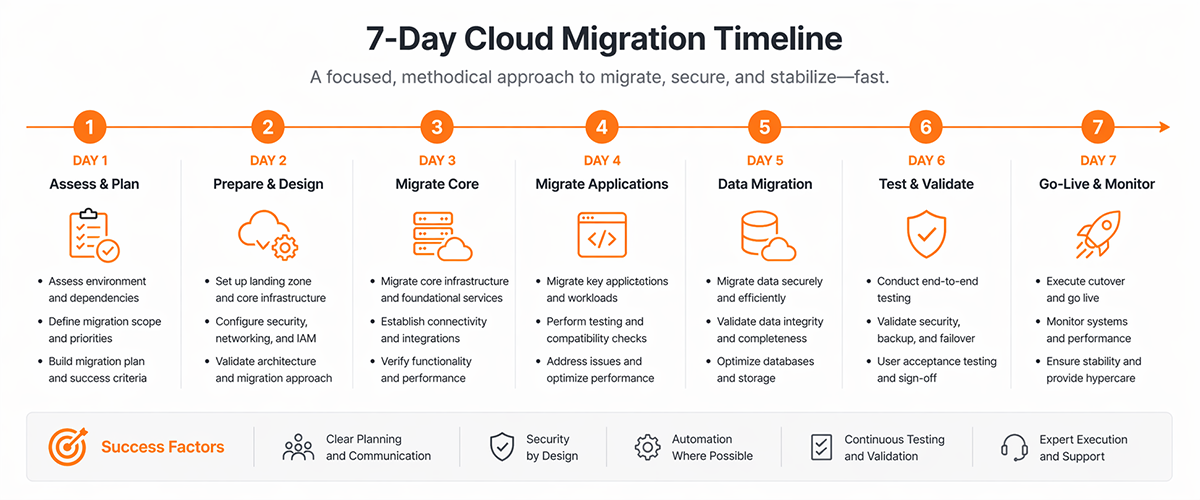
| Day | Phase | What Happened |
|
Day 1 |
Assess and Plan | Full assessment of the existing ERP environment and database dependencies. Migration scope and priorities defined. Success criteria established. Migration plan built and signed off before any technical work begins. |
|
Day 2 |
Prepare and Design | Landing zone and core cloud infrastructure set up outside the region. Security, networking, and IAM configured. Architecture and migration approach validated. Enterprise-grade backup and recovery platform established on European data centre infrastructure. |
|
Day 3 |
Migrate Core | Core infrastructure and foundational services migrated to the cloud environment. Connectivity and integrations established. Functionality and performance verified against baseline. |
|
Day 4 |
Migrate Applications | Key ERP applications and workloads migrated. Compatibility checks performed. Issues identified and resolved. Application performance optimized in the cloud environment. |
|
Day 5 |
Data Migration | All data migrated securely and efficiently. Data integrity and completeness validated against source. Databases optimized for cloud environment. Storage configured. |
|
Day 6 |
Test and Validate | End-to-end testing conducted across all systems. Security, backup, and failover validated. User acceptance testing completed and signed off. Final delta sync performed to capture any transactions during the migration window. |
|
Day 7 |
Go-Live & Monitor | Production cutover executed. Systems monitored for stability and performance. Hypercare period begins. Client team briefed on cloud environment operations. On-prem servers resting. |
The seven-phase structure is not bureaucracy it is what makes a 7-day migration trustworthy. Security by design, continuous testing and validation, and expert execution at every stage happened before go-live. Speed without structure is just risk with a faster clock.
Why This Is Not Just a Conflict Scenario
One of the most consequential decisions
It would be easy to read this story and conclude that geo-redundant cloud architecture is something you need only if you are operating in a conflict zone. That conclusion would be a mistake.
The scenario that triggered this client’s migration local infrastructure becoming inaccessible, connectivity failing, on-premise systems going dark can happen for a wide range of reasons that have nothing to do with geopolitical conflict:
in any cloud migration is the choice of model. Not every workload belongs in the public cloud, and not every business is ready for full cloud migration. Here is a straightforward comparison of the options most relevant to UAE businesses:
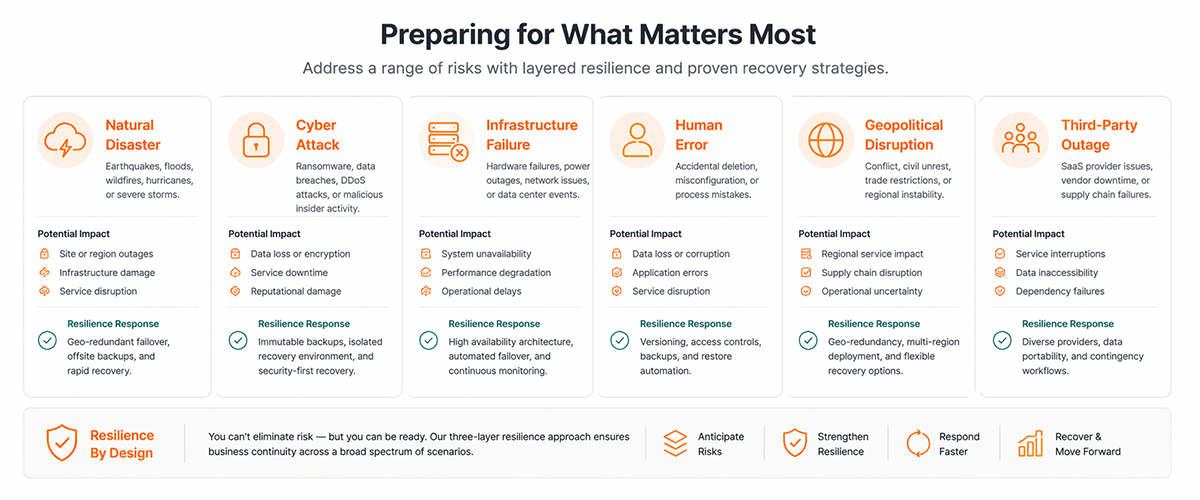
| Scenario | Impact Without This Architecture | Cloud Layer Response | Backup Layer Response |
| On-premise hardware failure | Single server or storage failure | ✓ Cloud environment unaffected | ✓ Backup available if needed |
| Local internet / ISP outage | Connectivity to on-prem lost | ✓ Cloud accessible via alternate routes | ✓ No data loss |
| Regional infrastructure attack | Local cloud and on-prem both disrupted |
✓ Primary cloud outside region active | ✓ Backup on separate platform |
| Primary cloud region outage | Primary cloud region disrupted | ✓ Geo-redundant secondary takes over | ✓ Enterprise backup intact |
| Ransomware on primary environment | Primary systems encrypted | ✓ Secondary environment isolated | ✓ Clean restore from enterprise backup |
| Natural disaster — local | Physical infrastructure destroyed | ✓ Cloud environment unaffected | ✓ All data preserved offsite |
Cloud Layer Response: ✓ Cloud production systems remain unaffected and operational.
Backup Layer Response: ✓ Backup remains available for rapid restoration if needed.
Cloud Layer Response: ✓ Cloud services remain accessible through alternate internet routes or remote access points.
Backup Layer Response: ✓ No immediate data loss occurs.
Cloud Layer Response: ✓ Primary cloud environment outside the affected region continues running.
Backup Layer Response: ✓ Independent backup platform remains secure on separate infrastructure.
Cloud Layer Response: ✓ Geo-redundant secondary cloud environment automatically assumes operations.
Backup Layer Response: ✓ Enterprise backup remains fully intact.
Cloud Layer Response: ✓ Secondary cloud environment remains isolated and operational.
Backup Layer Response: ✓ Clean recovery possible through enterprise-grade offsite backup.
Cloud Layer Response: ✓ Cloud environments remain geographically unaffected.
Backup Layer Response: ✓ All operational data preserved through offsite backup.
The question for every business is not whether any of these scenarios could happen to them. Most could. The question is whether their architecture is designed to keep the business running when they do.
The seven-phase structure is not bureaucracy it is what makes a 7-day migration trustworthy. Security by design, continuous testing and validation, and expert execution at every stage happened before go-live. Speed without structure is just risk with a faster clock.
The Data Protection Dimension: What Geo-Redundancy Means for Compliance
For businesses operating in the UAE particularly in regulated sectors data protection is not just an operational consideration. It is a compliance one.
The UAE’s data protection landscape has matured significantly. The UAE Personal Data Protection Law, the DIFC Data Protection Law, the ADGM Data Protection Regulations, and sector-specific frameworks from the CBUAE and Dubai Health Authority all create obligations around how data is stored, protected, and recovered. The direction of travel across all of these frameworks is consistent: organisations are expected to have documented, tested approaches to data protection and business continuity.
A three-layer architecture primary cloud environment outside the risk zone, geo-redundant secondary in a separate region, offsite backup on independent infrastructure provides both the operational resilience and the documented, auditable evidence of data protection that regulators increasingly expect to see.
It also addresses the data sovereignty question that we covered in our cloud migration by ensuring that data placement is deliberate, documented, and aligned with applicable regulatory requirements across all three layers of the architecture.
What This Means for Your Business: The Honest Assessment
Most businesses sit somewhere on a spectrum between two extremes.
At one end: fully resilient, geo-redundant architecture with tested backup and a documented recovery plan.
At the other: on-premise only, with a backup solution that may or may not work and no cloud environment to fall back on.
The majority sit somewhere in the middle perhaps with a cloud presence but no
geo-redundancy, or with backup in place but untested, or with a cloud migration planned but not yet executed.
The client in this story sat in the middle too, until events accelerated the timeline. The difference is that when the decision was made, Candor was able to move in seven days. Not every business will have seven day’s notice.
The right time to build resilience into your architecture is before you need it not during the event that reveals you do not have it.
The Takeaway

When the internet went down and the firewall failed, one UAE business kept operating because their ERP was already running on a geo-redundant cloud architecture with an independent offsite backup. Their on-premise servers the infrastructure they had depended on for years became irrelevant in a moment.
That is not a cautionary tale. It is a proof of concept.
The technology to build this kind of resilience exists, it is accessible to businesses of all sizes, and it can be implemented faster than most organisations assume. What it requires is the decision to make it a priority and a partner with the methodology to execute it properly.
The on-prem servers are resting. The business is running. That is exactly how it should be.
Build a Business Continuity Architecture That Works Under Real Pressure
Candor works with businesses to design and implement three-layer business continuity architectures combining enterprise-grade public cloud infrastructure, geo-redundant replication, and a dedicated backup and recovery platform into a resilience framework that keeps your business running regardless of what happens to your local environment.
We delivered a complete ERP migration in 7 days. We can do the same for your business.
👉 Get in touch with our team today.